الثلاثاء، 20 أغسطس 2013

Good citizen William

Normally, nobody's going to know the bare facts (unless I get struck down dead in the near future... which is not one of my current intentions). So I'm obliged to write this blog post. I've just ordered (through the Internet) no less than four items of relatively expensive black underwear, of the celebrated Eminence brand, made in France.


Before ordering, I even went to the trouble of phoning up the factory down in the Gard department to find out the identity of distributors who sell their genuine made-in-France production... and they gave me immediately a single famous name: Galeries Lafayette.

Now, if you think that the tone of my underwear story is somewhat overkill, that simply means that you've never had an opportunity of seeing me wandering around the house at Gamone, of an early morning, dressed in nothing more than cheap underwear purchased at the local Leclerc supermarket. Normally, I'm not an exhibitionist, but wearers of cheap supermarket underwear are obliged to become exhibitionists, unwittingly, through what the French refer to as la force des choses (literally, the force of things)... which means, in the present case, the force of hefty male genitalia striving constantly to fray their way through flimsy fabrics manufactured in places like Bangladesh.

Once upon a time, when I was a young fellow, we could buy clothes that lasted for ages. I remember, for example, having once tossed out, with iron in my soul, an archaic pair of moleskin trousers that I had brought with me from Sydney in 1962, because they had ceased to fit my bulky form several decades ago. They were manufactured by a legendary Australian firm named Fletcher Jones. This manufacturer still exists, but I have no idea whether they've adhered (probably not) to the fabulous fabrics of my youth. During my trip to Sydney in 2006, I asked the staff in a Fletcher Jones shop whether they still sold moleskin trousers, and they looked at me as if I were a Martian. These days, it's such a temptation to make money by using shitty fabrics from Bangladesh.

When I speak of being a "good citizen", I merely mean that I intend to purchase systematically, as far as possible, products that are made in France.

الاثنين، 19 أغسطس 2013

Nuclear submarines for Australia

Several years ago, I brought up the important subject of Australia's antiquated submarine fleet, and the question of an ideal replacement model:

— 26 December 2007, Australia's submarines [display]

— 2 January 2008, Australian arithmetic [display]

I evoked the idea that Australia might examine the feasibility of a French nuclear-powered vessel such as the Barracuda.


This interesting question of nuclear-powered vessels has given rise to a recent report entitled Nuclear submarines for Australia [display]. A link to the original green paper on this subject written by specialists at UCL [University College London] can be found here.

Camping site in Châtelus

My old friend Daniel Berger (an experienced wild-boar hunter) and his wife Michèle operate a delightful camping site across the other side of the Bourne, in Châtelus. Here's a photo of Daniel with his dog Milou.


I've just created a new version of their website, which can be accessed here.

السبت، 17 أغسطس 2013

French commercial property for sale

My friends Tineke and Serge spoke to me recently about a couple up near Lyon, named Bruno Richard and his wife Marie-Paul, whom they've known for ages, who would like to sell their charming rural hotel/restaurant, named La Jocondière, located in beautiful backwoods to the south of Lyon, near the village of Pélussin.


After analyzing the situation, and concluding that the affair appeared to be totally positive, I suggested that a good marketing strategy would consist of building a small website dedicated to the property in question. So, click here to visit my website (almost completed today)... whose address will get picked up rapidly, I hope, by Google.

If ever an Australian investor were interested in this interesting but out-of-the-way affair, it goes without saying that I would be happy to operate as an intermediary...

الخميس، 15 أغسطس 2013

Tricked by a donkey

Yesterday afternoon, when giving my donkeys a bunch of fresh thistles (their caviar), I was suddenly alarmed by the physical appearance of Fanette. Alongside the sleek silvery hide of Moshé, the 3-year-old female was terribly shaggy, and I had the impression that the forms of  bones were protruding in the region of her rump, as if she were becoming dangerously skeletal. The following photos, taken this morning, prove that Fanette is indeed shaggy, but they don't quite reflect the vision of my donkey that shocked me yesterday afternoon.


I jumped into the car and set off to St-Jean-en-Royans to ask the veterinarian for advice. When I explained that Fanette had not yet eliminated all her winter fur, the veterinarian told me that this has something to with the exceptional weather conditions over the last few months. Apparently he encounters a steady stream of owners of all kinds of animals—dogs, cats, horses, etc—who have observed the same phenomenon. In any case, the shaggy appearance of an animal that has retained a lot of its winter fur must not be interpreted as a symptom of any kind of health problem.

Have you seen any traces of diarrhea? No.

Are the donkey's rib bones visible? No, not at all, merely something that looks like rump bones.

Does the donkey appear to be eating well? Yes. Fanette gulped down the bunch of thistles so quickly that Moshé couldn't get in for a nibble.

Are you sure that your vision of "protruding rump bones" is not simply an illusion brought about by the presence of patches of thick fur alongside areas of bare hide? When I think about it, maybe you're right...

After leaving the veterinarian, I nevertheless dropped in at the local agricultural store to buy a bag of oats, on the off-chance that Fanette might be needing some kind of a boost in her summer diet. This morning, I had the impression that the donkeys looked at me as if they wondered whether I had gone crazy, serving them up fresh thistles and oats in the middle of their season of plenty, when they're surrounded by acres of luxurious grass and tasty weeds of all kinds.

In the following photo, you can distinguish the ridges of thick fur around Fanette's rump that looked to me like protruding bones, particularly when she was standing on sloping ground, and I was looking at her from behind.


You can also see the excessively fat bellies of both animals. The veterinarian told me that, ideally, I should be able to run my fingers over the sides of a donkey and feel the rib bones. For the moment, the main thing I feel on Fanette is fur. But how can you persuade a donkey to go on a diet?

OK, I was tricked by Fanette's fur. Now, when you've stopped laughing at me, let me ask you a simple question. Why do animals grow fur in winter, and then lose it in summer? Many of you probably said: To keep themselves warm in the winter cold. No, that's not a good answer. Keeping themselves warm in winter is indeed a favorable outcome of growing fur... but what I want to know is: What is the mechanism that makes the animal grow fur at exactly the time it's needed? You might have answered: Animals are designed that way. Fair enough... so long as you don't intend to say that God made them that way. Some of you might have added: Animals that happened to grow winter fur had a greater chance of survival (in the Darwinian sense) than animals without fur. That's true, too. But the answer I was looking for is the presence of genes, inside the donkey, that might be designated as a biological clock. A biological alarm clock, that rings a bell when the animal's fur-growing genes need to be triggered, in preparation for the forthcoming winter.

Geneticists have now identified precisely such biological clocks inside humans, and they are capable of studying the ways in which the operation of such devices can be upset by various external factors. We all know, for example, that some of our biological clocks become quite dysfunctional when we step onto a plane and fly to the Antipodes. And it takes a few days for the clocks to get back into a perfect operational state.

Getting back to Fanette, it appears that the internal mechanisms of her gene for shedding old fur have got screwed up by the weird weather. One day, donkey specialists with advanced training in genetic engineering will surely invent a technique for repairing biological clocks that have become temporarily unphased. Meanwhile, Fanette appears to be less upset than me about her shaggy appearance. And her old fur will inevitably be replaced by new fur by the start of the cold season.

الثلاثاء، 13 أغسطس 2013

Base-jumping, for and against

I've just heard that another base-jumper was killed this morning to the south of Grenoble, but I don't know yet whether it was at or near Choranche. At the end of last year, there was a mortal base-jumping accident at Choranche. The ensuing discussions, for and against base-jumping at Choranche, starred my friends Georges Pontvianne, of the Jorjane hotel-restaurant, and Bernard Bourne, dairy farmer and mayor of Choranche. They can be seen, in French (with good views of our cliffs), here and here.

Within our tiny village, it's a conflict of two cultures. There are only about 250 daredevils in France who practice this extreme sport (whose statistics indicate that it is only moderately dangerous), but our cliffs in Choranche (just above the Rochemuse floral park of Tineke and Serge) happen to be a world-famous address for base-jumping. Ever since settling down in Choranche, I've become accustomed to the idea that base-jumping is a permanent element of our local outdoor culture... but I must admit that I've never been tempted to get involved in this activity at a practical level. I love to look up at cliffs, and take photos. Before arriving in Choranche, however, I never imagined for an instant that there might be individuals who got a kick out of jumping off cliffs.

BREAKING NEWS: No, yesterday morning's accident occurred in the Obiou range, 70 km to the south of Grenoble, at an altitude of 2,400 metres. For reasons that remain unknown, a base-jumper failed to open his parachute. For the moment, apparently, weather conditions have prevented searchers from reaching the scene of the accident.

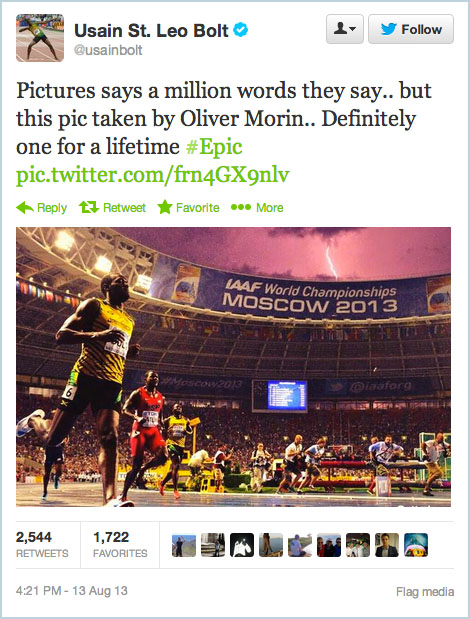
Photographer wins gold at Moscow

Here's a portrait of the real winner of the 100 m sprint at Moscow:


He's a photographer named Olivier Morin, who works for AFP. Even Usain Bolt himself tweeted his congratulations to the photographer.

Click here to see the famous photo. Click here to see the story of this amazing photo in Mail Online. And click here to access Olivier's Morin's portfolio.