Renault Kangoo
السبت، 16 مارس 2013
Billy has a Kangoo
الجمعة، 15 مارس 2013
Big-beaked finch has flown
An adjective that amuses me in the case of wild birds is "sedentary", which evokes a vision of a couple of tiny birds that have just flown in from Africa.
The male bird says to his wife:
It's time that I got around to naming correctly the beautiful bird that stopped here at Gamone for a week or so. I used to referred to it disrespectfully, here, as the "Galapagos guy". That was a silly nickname, because everybody knows that the passerine birds studied by Charles Darwin on the Galapagos were not in fact real finches.
My ex-wife (and constant friend) Christine Mafart succeeded rapidly (I don't know how) in identifying my big-beaked visitor. He was a Hawfinch [Coccothraustes coccothraustes, known in French as a Gros-bec casse-noyaux]. I use the past tense "was" because I think my bird has finally flown, after a brief stay at Gamone. I'm left with a set of splendid images of this exotic big-beaked creature, while hoping that he'll retain my address for a visit next winter.
This morning, I found another family of finches hanging around in the same area.
These dark little birds don't match the majestic beauty of my glorious pink-legged big-beaked Hawfinch... who liked to tap on my bedroom window, imagining his mirror reflection as an alien bird. I hope he'll be back here at Gamone in a year's time.
The male bird says to his wife:
"I don't know about you, dear, but I'm exhausted. In any case, I like this place. I got the address from a finch I ran into down in Morocco. He told me it's called Gamone, and the owner provides a regular stock of sunflower seeds. Why don't we settle down here for a while?"And the female bird replies:
"Sure, dear, you're preaching to the choir. You know I've always told you I wouldn't mind leading a sedentary existence, at least for a while, instead of our usual jet-set lifestyle, traveling constantly from one land to another. I'd be happy to just sit around in the sun... as soon as it appears. And I'm sure we'd have more opportunities to spend time with the kids."
My ex-wife (and constant friend) Christine Mafart succeeded rapidly (I don't know how) in identifying my big-beaked visitor. He was a Hawfinch [Coccothraustes coccothraustes, known in French as a Gros-bec casse-noyaux]. I use the past tense "was" because I think my bird has finally flown, after a brief stay at Gamone. I'm left with a set of splendid images of this exotic big-beaked creature, while hoping that he'll retain my address for a visit next winter.
الخميس، 14 مارس 2013
Work for a doctoral scholar in French history
Once upon a time, if you had asked me what the word "terrier" means, I would have said that it designates the kind of little dog you see in the celebrated painting of His Master's Voice. As a boy in South Grafton, I used regularly a spring-driven 78 rpm gramophone to play vinyl records, many of which carried the familiar image of the fox terrier.
Ignoring languages and etymology, I could not know that our own lovable smooth fox terrier on the farm at Waterview derived his name from the fact that he was an "earth dog" (Latin terra, "earth"), capable of burrowing into the ground in search of foxes.
Upon my arrival here in Choranche, a couple of decades ago, I heard of a second meaning of the word "terrier": a register of parcels of land whose owners owe allegiance (or taxes) to such-and-such a lord or superior body. That definition isn't meant to be rigorous.
In the space of a few years, by accident, I've stumbled upon two separate terriers concerning the Royans region in which I live. And, in both cases, I've obtained an authorization enabling me to publish, through a website, the original documents of the terrier in question. Each of my bulky Flash-based websites takes a while to load.
• 14th-century terrier
Upon my arrival here in Choranche, a couple of decades ago, I heard of a second meaning of the word "terrier": a register of parcels of land whose owners owe allegiance (or taxes) to such-and-such a lord or superior body. That definition isn't meant to be rigorous.
• 14th-century terrier
Established by the Sassenage family in 1351-1356. website• 18th-century terrier
Established by the Order of Malta in 1780. websiteIn the context of French history, it's exceptional that two sets of precious documents of this kind, covering a time span of four centuries, have survived, and are available today for study. The investigation of these two quite different terriers would surely be a fascinating theme for a doctoral scholar, maybe attached to a university in the UK or America. I would be happy to handle requests for further information from interested researchers.
Primroses in the snow
The burgeoning primroses of Gamone were surely surprised to discover that, during the night, flakes of late-winter snow had fallen upon their delicate cream petals.
This chilly remnant of the cold season will no doubt stimulate the tiny flowers, and incite them to hurry up in their urge to welcome the approaching spring. As they might say in Rome (if their Latin was as elementary as mine, and if they weren't preoccupied by other less natural arrivals): Habemus primulam, primum tempum. The primrose has arrived and, with it (soon, in any case), spring.
الأربعاء، 13 مارس 2013
Owner of Gamone in 1823
For the first time in ages, I drove up to Grenoble yesterday and spent an hour or so in the archives. In the context of my research concerning the history of my house at Gamone, this short visit to the archives was most fruitful, in that I succeeded in obtaining the name and identity of the man who owned my house and property at Gamone some two centuries ago. Let me explain how this happened.
Today, my property includes parcel #723 (a former vineyard) as well as a group of additional parcels up in the top left-hand region of the map. As indicated in the diagram, I discovered yesterday that my Gamone property was owned in 1823 by Michel Grégoire Tézier [1761-1833], the mayor of the neighboring village of Pont-en-Royans... shown in this spectacular panoramic photo that I found on the web:
A few years after crowning himself in the cathedral of Notre-Dame de Paris, on 2 December 1804, in the presence of the pope Pius VII, the emperor Napoléon Bonaparte created the interesting concept of a national cadastre: that's to say, a vast map indicating the ownership of every fragment of real estate in France. Here in the corner of the Isère department where I live, the Napoleonic cadastre was only published—as indicated in the following oval title box [called a cartouche in French]—on 19 March 1823, a year or so after the death of the former emperor on the remote island of Saint Helena in the South Atlantic Ocean.
[Click to enlarge]
Here's an outline of the central parcels of the Napoleonic cadastre for my house (parcel #717) and land at Gamone:[Click to enlarge]
Now that I've unearthed the identity of this eminent landowner (who had used his personal fortune to acquire real estate that came onto the market in the wake of the French Revolution, when the great religious establishments were disbanded, and their possessions sold), I should be able to move further backwards in time, and discover the exact identity of the owner of Gamone on the eve of the French Revolution.
الاثنين، 11 مارس 2013
Basic vegetarian rissoles
My gastronomical enthusiasm for supermarket minced steak (for my standard chile con carne dish) was dampened by the recent horse-meat affair. And vegetarian urgings emerged in my imagination. Unfortunately, such urgings remain largely cerebral, rather than making my mouth water. That's surely a cultural failing due to the fact that I've never really been initiated by friends, restaurants and fine cooking into the marvels of meals without meat. To be totally honest, I lived for years under the ridiculous illusion that vegetarians were weirdos with visceral links (maybe there's a better adjective than "visceral") to astrologists, alchemists, religious ascetics, Seventh-Day Adventists and six-day bike-riders. I imagined that you would only have to ingurgitate a few vegetarian dishes and you would soon find yourself refusing, not only pork, but alcohol and vaccinations. Retrospectively, I realize to what extent I've often "reasoned"—even as an adult—in a ridiculous mindless fashion, governed by a set of stupid superstitions, no doubt developed during my boyhood. So I hardly need to explain that I remain, for the moment, an uninspired and uninformed vegetarian cook: the equivalent of the proverbial husband in the kitchen who can't boil an egg.
Back in 2011, I was proud to have unfathomed, as it were, the secrets of a mythical meat dish from a Greek restaurant of my student years in Sydney [access]. Today, my culinary achievements, far more modest, are presented in the following dull photo, which would be rejected instantly by any self-respecting cooking magazine or website.
Here, there is no horse meat. Indeed, there is no meat of any kind whatsoever. My delicious rissoles are fake steaks, concocted out of soy protein and dried cereals (oats, wheat, etc).
I was interested to learn that it's easy to store such uncooked rissoles in the deep-freezer. And they can then be cooked easily and rapidly on an iron grill plate placed above my gas burners, with a little olive oil.
As you can gather from the presence of the two bottles in my photo, I tend to be a heavy-handed user of both Worcestershire sauce (like my Walker uncles out in Australia) and soy sauce... which explains why my vegetable mixture (deep-frozen product) has a blackish look. Basically, though, the above meal is unadulterated (clearly-identified ingredients), tasty and healthy.
السبت، 9 مارس 2013
What is there in common...
... between me and the Sistine Chapel?
Did I hear somebody say that, what's in common is that both William and the Sistine Chapel are fine examples of Renaissance splendor? Well, if you insist... but that's not the right answer. I'll give you a hint. The answer to my question has something to do with our respective roofs (or rooves, if you prefer).
Here's the answer.
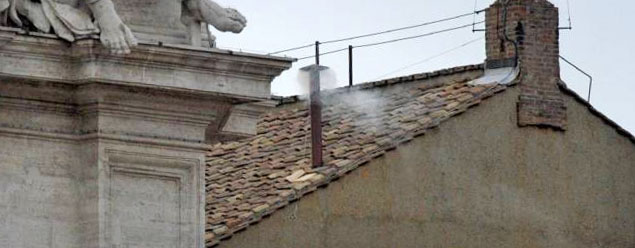
Like me, the people at the Sistine Chapel are installing a new chimney on their roof.
Here's my Gamone chimney, which I intend to install as soon as possible.
I don't know what brand of chimney the Sistine Chapel has decided upon, but I can assure them that the French-manufactured Poujoulat product is excellent.
As soon as my new chimney and wood stove are installed, I intend to test the system by burning some old papers. If all goes well (that's to say, if the chimney joints are all OK), then I should see white smoke emerging from my new chimney. (If not, it's my house that's likely to fill up with white smoke.) Now, to avoid potential misunderstandings, I want to make it perfectly clear, by means of the present blog post, that I have no intention whatsoever of electing an antipope at Gamone. On the other hand, I cannot deny that I've often thought that my dog Fitzroy has all the necessary qualities for that job. There's a technical problem, though. Fitzroy has not yet become a cardinal.
الاشتراك في:
الرسائل (Atom)