الاثنين، 6 مايو 2013

Dog contemplating the greenery

With all the recent rain, it's not surprising that Gamone is surrounded in greenery.


Often, Fitzroy remains motionless, pensive, apparently contemplating the surroundings, soaking in the greenery.


On the roadside up beyond the house, he turned his head around for the photo:


Otherwise, he's more interested in the greenery than in me.


I wonder if he recalls the scene, not so long ago, when all this was covered in snow.

السبت، 27 أبريل 2013

Bodies as billboards

These days, people often paint themselves with their colors.


They use their bodies as a support for the transmission of messages. In this case: "We're supporters of England." An oldtimer such as myself sees this widespread habit as something new. Our generation never did this. We didn't have enough imagination, or maybe we were prudish about the idea of using our bodies for such purposes. The young women of my generation—in Australia and later in Paris—hardly even used facial makeup. The idea of using the human body as a support for imagery is nevertheless ancient.


Five years, a young Ukrainian women, Anna Hutsol, gave body painting a fascinating new twist and revolutionized the impact of corporal messages through her creation of the Femen movement.


Since then, throughout the world, Femen adepts use their bare-breasted torsos as billboards for political statements, generally in the domain of women's rights. Here's a portrait of co-founder Sacha Chevchtchenko, with the Femen logo painted on her breasts:


Femen's initial vocation was radical feminism, including the fight against prostitution. These days, frequent targets of Femen activists include Islamists and dignitaries of the Roman Catholic and Orthodox churches. Recently, a courageous Femen-inspired action was carried out by 19-year-old Amina in Tunisia, whose naked breasts carried the message: "My body belongs to me, and is not the source of anyone's honor."


Yesterday, the French branch of Femen complained in a tweet about the removal of the following provocative photo from their Facebook page:


Insofar as Femen bases its actions upon representations of semi-naked women, a thin line can separate some of their happenings from pure esthetics and spectacular eroticism. This is the case, I feel, concerning the above image.

الأحد، 21 أبريل 2013

Now we know how he did it

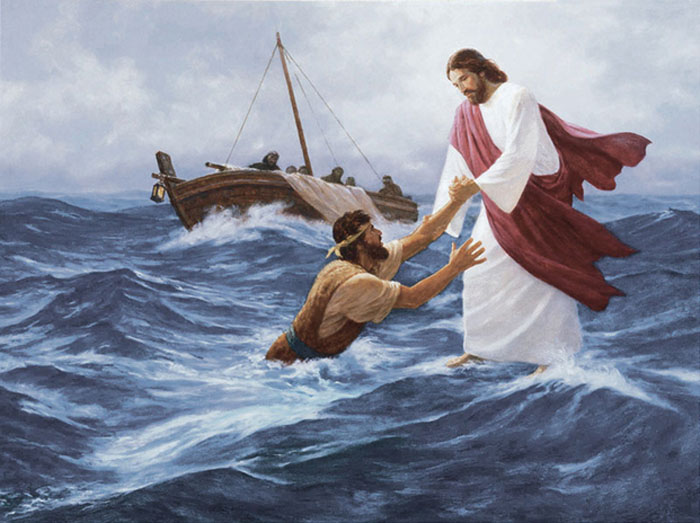
I think that one miracle in particular has become more famous than all the others, for the simple reason that almost everybody has tried to perform it, at one time or another... and nobody has ever succeeded unquestionably in repeating the accomplishment of Jesus. I'm referring, of course, to the marvelous story about Jesus walking on the surface of the waters of the Sea of Galilee.

It was now late and the boat was already well out on the water, while he was alone on the land. Somewhere between three and six in the morning, seeing them labouring at the oars against a head wind, he came towards them, walking on the lake. He was going to pass by them; but when they saw him walking on the lake, they thought it was a ghost and cried out; for they all saw him and were terrified. But at once he spoke to them: 'Take heart! It is I; do not be afraid.'
— Mark 6:47-50
According to Matthew 14:28, Peter decided spontaneously to have a go at this feat, and it seemed to work for a few seconds. But his faith collapsed almost instantly, and he started to sink into the water.

Recently, a small team of determined athletes, equipped with special water-repellent running shoes (of a brand that I'm not allowed to name here, because of my sporting sponsors), succeeded brilliantly in racing some 20 meters across the surface of a lake.


But these courageous fellows haven't yet deciphered the great Jesus secret that consists of having sufficient pure faith in God to believe totally that He will hold the walker's body above the surface at all times, making it possible to stroll peacefully and fearlessly across the water.

There was a gigantic breakthrough recently when marine archaeologists discovered a massive ancient stone structure under the surface of the Sea of Galilee. Click here to see this fascinating story. A diagram from Shmuel Marco makes it clear at last, after two millennia of mystification, exactly how Jesus was able to carry out his trick.


At that time, the depth of the Sea of Galilee was slightly less than it is today, which meant that the tip of this huge but hidden stone "iceberg" lay just below the surface. So, Jesus—who had no doubt practiced this feat tirelessly, to get it right for the day of his celebrated demonstration—simply paddled around on a small more-or-less flat zone at the tip of the structure, creating the illusion that he was walking on the water.

Archaeologists say that they can't explain who might have built this underwater mound. Nor why and when it was erected. I'm surprised by the archaeologists' lack of imagination. To my mind, it's clear that Jesus himself had collected funds enabling him to employ a team of stonemasons to build this structure, for the sole purpose of performing his spectacular miracle. In nearby Egypt, various pharaohs had found the means of erecting far greater masses of stone, the pyramids, in order to promote their theories of an afterlife. Since miracles play such a fundamental role in Christianity, I find it perfectly plausible, indeed normal, that Jesus might have gone to the trouble of building his own relatively small tumulus. Besides, since it was underwater, it didn't have to be as fancy as the Egyptian models, because the whole idea was that nobody should see it.

The only authentic miracle in this rather shabby tale is the fact that, as far as we know, no fishing boats ever ran aground on this big pile of rocks.

Quest for new worlds

It's never too early to start looking around for new worlds that might be colonized, one day, by our human descendants. Incidentally, it's becoming more and more likely that many of these descendants, in the not-too-far-distant future, will be quite different creatures to us, since their genomes will no doubt contain various synthetic genes inherited from top-class intelligent robots. There's no sound reason—other than old-fashioned nostalgia—for hanging around here longer than necessary on the charming planet Earth, with its depleted resources and damaged ecosystems. Adventurous human societies should be able to take advantage of their Earth-based history and experience in order to go about things in a better fashion at other spots in the universe.

We first have to find new worlds, and then our descendants will have to invent some way of reaching them. Theoretically, neither of these two challenges would appear to be insurmountable... though I don't have the least idea of what the solutions might look like. When our descendants get around to finding solutions to the above-mentioned challenges, they'll surely be amazed to think that we old-timers of the start of the 21st century were incapable of envisaging such answers.

Astronomers in search of new worlds evoke the celebrated children's story of Goldilocks and the three bears, by the English romantic poet Robert Southey [1774-1843].


The Goldilocks metaphor is a little like the Down Under joke at the end of one of my recent blog posts [display]. In the empty house of the three bears, in the middle of the woods, the little girl comes upon three bowls of porridge, apparently ready to be eaten. Feeling hungry, she tastes the porridge in Father Bear's big bowl, but it's too hot. Then she tries the porridge in Mother Bear's bowl, but it's too cold. Finally, in Baby Bear's little bowl, Goldilocks finds that the temperature of the porridge is "just right", so she gulps it all down. In the case of planets orbiting around a star, there is sometimes an orbital zone whose temperature, like that of the planet Earth, is apparently "just right" for human existence.

Last week, astronomers were thrilled to announce that NASA's Kepler spacecraft had discovered a pair of so-called exoplanets orbiting within the Goldilocks zone of a star that is henceforth named Kepler 62, located in the constellation Lyra, at a distance of 1,200 light-years from our solar system. Here's an artist's impression of a "sunrise" in the vicinity of one of these planets:


The chief of the Kepler project, William Borucki, claims that this pair of exoplanets is the most favorable site for life that has ever been detected by the Kepler spacecraft since its launch by NASA in March 2009. Click here to visit the Wikipedia page on this project.

Meanwhile, plans are already under way for NASA's next-generation spacecraft designed to look for new worlds. Called the Transiting Exoplanet Survey Satellite (TESS), and designed by teams at the Massachusetts Institute of Technology (MIT) headed by George Ricker, the new vessel will be launched in 2017. Here's an artist's impression of the TESS spacecraft:


The hundreds of small exoplanets discovered by Kepler have all been linked to stars whose great distance means that they're faint. TESS, on the other hand, will examine bright stars in a much larger area of the heavens. So, there's a good chance that this new spacecraft will be able to find new worlds for our descendants.

One might imagine a latter-day Columbus setting out towards obscure shorelines. The TESS adventure reminds me rather of future oak forests planted by conscientious landowners who know full well that neither they nor even their immediate offspring will ever sit in the shade of those great trees.

السبت، 20 أبريل 2013

Adding spice to my existence

This looks like a quite ordinary fruit salad, composed of sliced apples, pears, oranges, strawberries and kiwifruit.


The photo doesn't reveal what's special about my fruit salad: the succulent spicy brown syrup in which the fruit fragments are bathing. So, let me explain how I came to develop (almost by chance) this delicious dessert.

My blog post of 26 July 2012 entitled Roast pork "Bangkok-en-Royans" [display] extolled the merits of a seasoning powder produced by a firm in the port of Samut Sakhon (Thailand), a few dozen kilometers south-west of Bangkok. This piece of pork shoulder, prepared this morning using this product, will be left to marinate until tomorrow, when I'll bake it slowly at a relatively low temperature.


A few days ago, when I dropped in at the small shop in Romans where I purchase Asian foodstuffs, I ended up chatting with the lady in charge about the principal ingredients in this powder: cinnamon and anise. I was particularly interested in the exotic fruit known as star anise (badiane in French).


The pharmaceutical industry had found that this everyday Chinese product (also grown in southern NSW) could be used to manufacture the Tamiflu anti-influenza drug. In the context of the swine flu outbreak in 2009, the price of star anise soared astronomically. Happily, since then, researchers have learned how to use bacteria instead of the Illicium verum flowers to produce the anti-influenza drug, and packets of star anise (either as dried flowers or ground into powder) are, once again, quite cheap.

I bought a big packet of ground star anise. At home, I started looking around on the Internet for interesting ways of using this fragrant product... and that's how I came upon the recipe for my fruit salad. Besides, the weather had become exceptionally warm, and the idea of eating fruit with a flavor of pastis liquor attracted me. First, I needed another ingredient: brown cane sugar.


The syrup is made by dissolving a large quantity of sugar in boiling water. (With a sense of guilt, I prefer to employ the fuzzy adjective "large", since we know already that even the smallest quantity of sugar used to make syrup is excessive from a health viewpoint.) To spice up the syrup, I mixed in a teaspoon of star anise, a teaspoon of cinnamon, a teaspoon of cloves, a few drops of vanilla essence and the zest of an orange and a lemon. After the syrup had been bubbling for a few minutes, I poured it onto my fragments of fruit, which tended to cook them slightly. When the mixture had cooled down, I covered the bowl in cellophane, and left the salad in the refrigerator overnight. This salad is delicious with vanilla ice cream.

الثلاثاء، 16 أبريل 2013

Fitzroy in love

The warm weather has set in, and the grass at Gamone is green. Almost overnight, throughout the region, white blossoms have appeared on the cherry trees. My humble old tree on the corner mound (alongside Sophia's tomb) is doing its best to imitate the splendid young cherry orchards down in the valley, on the rich soil of the banks of the Bourne and the Isère.


It doesn't take much romantic imagination to consider that the warm weather, the green grass and the white cherry blossoms announce that the season of love is starting. That's how Fitzroy feels things. Over the last few evenings, he has been leaving Gamone regularly for short excursions to an unknown place. Yesterday afternoon, when I let him off the chain for a moment, while I was doing odd jobs outside, Fitzroy took advantage of a minute of inattention to disappear... and he hadn't returned to Gamone this morning. I went out in the Kangoo to search for him, in vain.

Martine, the postwoman (who knows everything that's happening in the neighborhood), informed me that she had sighted Fitzroy over on the other side of the Bourne, in Châtelus. I immediately dashed across there in the car. Members of the Huillier family told me that Fitzroy had often been hanging around their houses over the last few days. A young lady said in a whisper, as if it were a secret item of uncertain information: "I have the impression that your dog is in love with my mother-in-law's dog." As for Fitzroy, he was nowhere in sight. My friends told me that my dog's usual habit was to collect his beloved female from the farmhouse and take her for a promenade on the wooded slopes below the Cournouze. I left my phone number and asked them to let me know as soon as Fitzroy returned.

Within an hour, I got a call saying that Fitzroy and his lover had been sighted in the tall green grass beneath a single cherry tree located in the middle of their walnut orchard. When I arrived on the scene, it was truly idyllic. From the road, all you could see were the black tips of the ears of the two dogs protruding from the tall grass, surrounded by a thick canopy of magnificent cherry blossoms. When I called, Fitzroy recognized me instantly, and started to move towards me. But he faltered from time to time, looking back over his right shoulder at his loved one, who remained under the cherry tree. After a little coaxing, the two dogs moved towards the Kangoo, and I was able to attach Fitzroy to a lead. He was still in a state of tender attachment to his female friend, and the two dogs were constantly rubbing up against each other. Fitzroy finally jumped into his wooden pen at the rear of the Kangoo. As soon as I drove off, however, he realized that I intended to take him away from his romantic haven, and he started to express his indignation vocally. Back at Gamone, I was of course obliged to enchain my lovestruck friend... and provide him with sustenance.


I wasn't proud of my intervention. It's not nice to tear apart a burgeoning relationship. Love in the grass under a canopy of cherry blossoms is fine... but what I don't like is the idea of Fitzroy returning by means of the Rouillard Bridge over the Bourne, and the main road up to Gamone. Meanwhile, Fitzroy is catching up on lost sleep. By the time he wakes up, I hope he will have forgotten my unkind act. What he won't forget so easily, of course, is the aroma of his loved one, which surely continues to waft across here in a direct line, like powerful bursts of a laser beam.

الأحد، 14 أبريل 2013

Bastille blues

In his wonderful book entitled Jerusalem, City of Mirrors (1989), the late Amos Elon [1926-2009] spoke of a mysterious affliction referred to as the Jerusalem syndrome. Affecting American Protestant males, almost exclusively, this torment causes them to take off their clothes, evolve into a state of crazy ecstasy, and preach nonsensical prophecies to passers-by on street corners. After a few days in hospital, victims recover their normal behavior as calm tourists in the Holy City, and they even feel good about their traumatic experience. Psychiatrists explain that victims of this affliction arrive in Jerusalem with a preconceived but totally false vision of the place, which they've always imagined as a gentle and harmonious Holyland: a pastel-hued picture from a children's book.


When such a visitor discovers the stark present-day Jerusalem, and finds it totally unlike his vision, his convictions are shattered traumatically... and his subsequent reactions and behavior express his momentary desire to be born again (naked, of course) into a reassuring but make-believe Christian context.

Here in France, a similar kind of affliction—which I designate as the Bastille blues—affects certain local intellectuals.


Typical signs of this disturbance are a sudden obsession that we might be on the eve of a replay (with variations, naturally) of the French Revolution of 1789. Victims of the affliction start to be hallucinated by visions of rioting, smoke and flames, destruction, bayonets, gunshots, guillotines... but they generally keep their clothes on. In May 1968, the youth of France were totally intoxicated by a severe case of Bastille blues.


Fortunately, the summer holiday season arrived just in same to save the nation from descending into total anarchy. And afterwards, everybody felt so much the better for having let off so much steam... much like a patient emerging from an attack of the Jerusalem syndrome.

A few days ago, I was intrigued to discover that a prominent French journalist, Franz-Olivier Giesbert, was apparently suffering from a massive onslaught of Bastille blues.


In his role as chief of the weekly magazine Le Point, he has written an editorial suggesting that France is bogged down in a pre-revolutionary quagmire.


Click here to access the French article. Not surprisingly,  64-year-old "FOG" (the acronym has become Giesbert's nickname)—born in Washington, and impregnated with Franco-American culture—backed up his claim by evoking the works of the celebrated viscount Alexis de Tocqueville [1805-1859]: in particular, his masterly analysis of the events and climate of 1789, The Old Regime and the Revolution, which describes the French people's appalling erosion of confidence in their monarchy.


Today, it's a fact that the Cahuzac affair [click here to see my recent blog article entitled Champion liars] has had a disastrous effect upon the waning respect of French citizens for their political leaders. Has modern France truly lost hope in its destiny? Is one half of the nation ready to cut the heads off the other half? Have the French become totally pessimistic and cynical? What has gone wrong?

Basic differences between American and French attitudes to economic progress are illustrated by a humorous anecdote concerning the reaction of onlookers towards a prosperous fellow who drives by in a luxury automobile. A typical American might ask himself: "What can I do in order to buy myself a car like that?" A typical Frenchman would complain: "Why doesn't that wealthy weasel drive a worn-out jalopy like the rest of us?" In the above article, FOG evokes the metaphor of François Hollande scooting around on an antiquated Vespa, while some of his acquaintances drive Ferraris. This image of an old-fashioned president, no longer on the same wavelength as progressive citizens, is made explicit in the cover of the current issue of FOG's weekly.


The rhetorical question "Pépère, est-il à la hauteur ?" could be translated as follows: "Can Grandpa still handle things?" Many citizens are starting to consider that the answer to that disturbing question might indeed be negative. But maybe, hopefully, there are plausible remedies that would fall short of a bloody revolution.

BREAKING NEWS: The Bastille blues theme has become quite explicit in the cover of the latest issue of the weekly: