Over the last few days, Gamone has been bathed in sunshine: a pleasant change from being bathed in chilly wetness. Prolonged periods of overcast skies, low temperatures and dampness end up by demoralizing us at a physiological level. Our brains run short of whatever it is that comes from sunshine (vitamin D, I'm told), and we start to slow down. It's as if an audacious
Lance Armstrong were to tackle the tortuous slopes of
Alpe d'Huez with nothing more in his athlete's body than miserable food and water. Sooner or later, you stop... and the only possible strategy is to wait around until the sunshine returns.
Around the house at Gamone, there are several indubitable signs that the time has come to stop hibernating, and get back into outside action. Here, for example, is one of the more obvious signs:
Once upon a time, I used half an old fuel barrel, screwed onto legs made out of steel bars, to erect a makeshift barbecue, but the heavy contraption was unstable, and it finally rusted away. A few days ago, I was attracted by the relatively low price of a charcoal barbecue at the local Leclerc supermarket. The model on display looked remarkably solid, and it seemed to be a better deal than similar-looking products (but with one less leg) from the German firm
Weber. I soon realized that the low price was due to the fact that this barbecue—brand name
Rhodes—came as a kit, made in China, which had to be assembled by the purchaser. Maybe I was intrepid, but I liked the sturdy style of the model on display, and I guess I was intrigued to see how a Chinese manufacturer would behave in the build-it-yourself world dominated by Ikea. Well, let me say that I was totally amazed by the high quality of the Chinese presentation, which made it a pleasure to assemble the barbecue on the basis of extremely detailed diagrams of a down-to-earth kind. I had the impression that I was being invited to perform the assembly tasks in an old-fashioned environment of nuts and bolts, solid steel and precise measurements. Fortunately, I went about things by examining closely the big pile of items that were crammed inside the cardboard box from China. And I also took time to analyze every minute detail in their almost-wordless diagrams. Opening a plastic bag full of an undocumented assortment of nuts, bolts, screws and washers, I said to myself that it was highly unlikely that I would discover the intended role of every small item in this pile. On the contrary, when I reached the end of the assembly tasks, I was amazed to find that I had succeeded in identifying every object in the pile (including dozens of metal and fiber washers of differing sizes), and that not one single surplus item remained. All in all, the Chinese approach to the manufacture and presentation of this product was perfectionist. I had the impression that every minor element of the product had been designed by a team of engineers, and manufactured according to millimetric specifications. I found myself in the old-fashioned world of sustainability, where things are made to last. Needless to say, this was a quite unexpected experience.
On a nearby table, I've assembled a trivial demonstration of sustainability of a another kind.
On the left, you have the remnants of plastic
Gardena devices that didn't survive the combined assaults of winter and
Fitzroy. On the right, you see specimens of metallic items that I've just purchased to replace the cheap plastic junk (which turns out to be expensive when you have to replace it each year). I find it inadmissible that a manufacturer proposes an item such as the plastic nozzle while knowing full well that it will develop cracks if left outside in wintry conditions. And I have the impression that the orange parts of their plastic products have been designed deliberately to attract the teeth of dogs.
Now that the weather is starting to warm up, one of my first tasks will be to finish work on the carport, which needs to be boarded up on the far side.
The remaining firewood that was stacked up in the vicinity of the carport has now been shifted down to a place alongside Fitzroy's kennel.
Between now and next winter, I intend to erect a big wood shed in this zone, so that a truck can simply unload wood right alongside the shed.
Another sign of work about to start is the presence of a big pile of gravel at the entry into the front yard.
Meanwhile, a curious wall of small rocks has appeared on the edge of the huge embankment in front of the house, just to the right of the gravel heap.
So, what's happening... or about to happen? First, let me explain briefly—while refraining from jumping ahead in my story—that I spent a strenuous day raking up all those stones from inside the cellar of my house, and using a wheelbarrow to deposit them at this convenient spot. Now, as far as future Gamone projects are concerned, the following photo provides an answer:
Those pinkish objects are the elements of a future wood oven for baking bread, pizzas, etc. The dozen or so fragments have been molded out of a special refractory cement composed primarily of crushed volcanic rocks mined in the nearby Ardèche
département. The oven I've chosen, produced by the
Ephrem company in Provence [click
here to visit their website] is called the
Pizzaiollo... which is a Frenchified (but misspelt) version of the Italian word for a guy who makes pizzas.
Now, where am I going to install my future oven? For a long time, I imagined using a spot outside the southern façade of the house, where I discovered vestiges of an ancient bread oven (since turned to dust) when I first settled down at Gamone, some 20 years ago. But I've often wondered: Would I be prepared to wander outside the house on cold evenings, into the darkness, to fire up an oven to bake a loaf of bread or to cook a pizza? Maybe I would do so for a while, but I would probably drop the habit. No, the ideal solution would consist of placing the wood oven inside the house, where I can access it easily and use it regularly at all times of the year. But that would mean constructing an additional chimney to evacuate the smoke... and I haven't yet terminated the project of installing such a chimney for my wood stove. Well, it was
Christine, in the course of a casual phone conversation, who first evoked a possible location: in a corner of the ancient cellar alongside my house. Why not?
It's not easy to take meaningful photos of my cellar at Gamone, because there's little light and you're in an essentially closed space surrounded by stone. Here's my attempt to take a photo of the far wall at the northern (cold) end of the cellar:
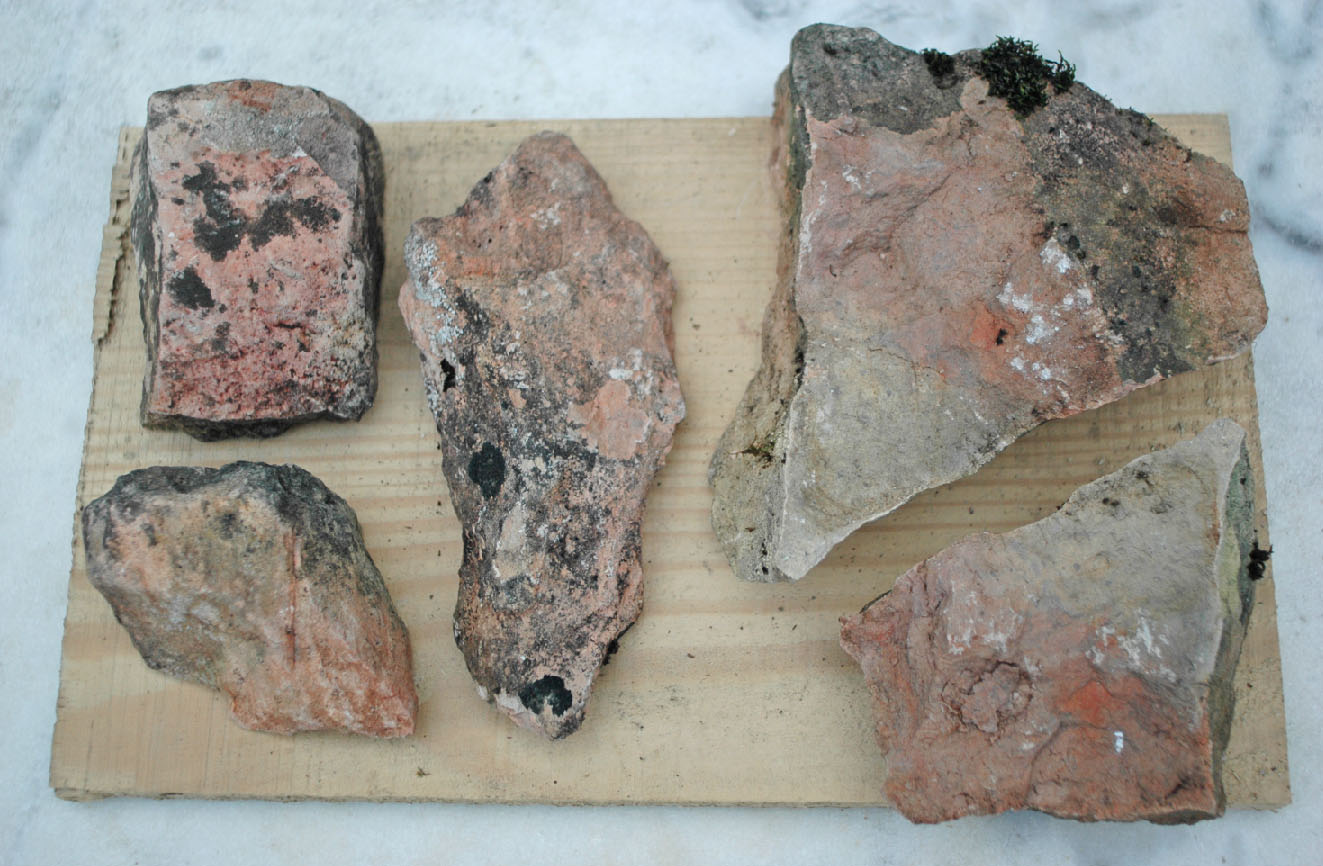
The vertical sections of the cellar walls are composed of irregularly-shaped blocks of calcareous stone (no doubt picked up on the slopes in the vicinity of Gamone) held together by lime mortar. Then, starting at a height of about 2 meters, the ceiling of the cellar is composed of finely-cut and precisely-assembled blocks of an exotic mineral substance commonly called
tuf calcaire in French. I've only just discovered that the correct technical name of this sedimentary rock, in English, is
travertine. [Click
here to see the Wikipedia page on this subject.] In a blog post that I wrote back on 2 July 2009 entitled
Vegetal rock [
display], I referred to this substance (rightly or wrongly) as "calcareous tufa", but I shall make a point, from now on, of calling it travertine.
In the above photo, one has the impression that there's an arched doorway blocked by earth. This remains a basic Gamone mystery, which I have not yet elucidated satisfactorily. For the moment, I'm convinced that the earth blocking that would-be doorway has been there forever. That's to say, the doorway has never been open at any moment of its existence. The earth was there when the doorway was constructed, and it has never been touched since then (except by me, a year or so ago, when I started scratching at that wall of hard earth with the idea of maybe erecting a staircase at that place). Indeed, that earth is part of a layer that was used as formwork (
coffrage in French) when that entire far wall was erected... maybe in the vicinity of the year 1600 (judging from similar constructions at the Chartreux monastery in Bouvante). And, if the builders never got around to removing the earth and transforming the alcove into an effective doorway, that was no doubt because their building operations were hindered by obstacles (maybe even religious warfare) and finally abandoned. But I've never succeeded in putting together a clear and convincing explanation of what might have happened. So, we're left with a blocked would-be doorway... which I will surely end up opening, one of these days, by means of a staircase ascending to the outside level, just beneath the arch.
As for the slanted and cemented opening near the summit of the vertical wall, that would appear to be the result of a relatively recent operation carried out by a grazier, rearing animals in the cellar (maybe goats), who wanted to be able to toss hay down into the cellar.
In any case, it's here, in the right-hand (north-eastern) corner of the cellar, that I intend to install the future wood oven, so that I can take advantage of the "hay hole" in the ceiling as a convenient exit for a smoke chimney.
The following maquette provides a rough idea of the form of the future wood oven:
The area covered by the oven is a square of 140 cm x 140 cm, which fits neatly into the corner of the cellar. I hasten to point out that the proportions and layout of this maquette are basically valid, but it's rather fuzzy as far as the external finish of the oven is concerned. For the moment, I can't guarantee that I'll succeed in covering the upper part of the structure with stone bricks (maybe composed of travertine). It's possible that I'll finally resort to a solution of roughcast ocher plaster (
crépi in French). And I'm not yet sure of the way in which smoke from the oven will be channeled from a point just above the oven entry to the "hay hole".
Now that spring has sprung at Gamone, I've got "
du pain sur la planche" (bread on the breadboard: a French metaphor for problems to be solved, work to be done). That's the way I like life.